
Puebla and Cholula Day Trip from Mexico City: Beyond the Famous Pyramid
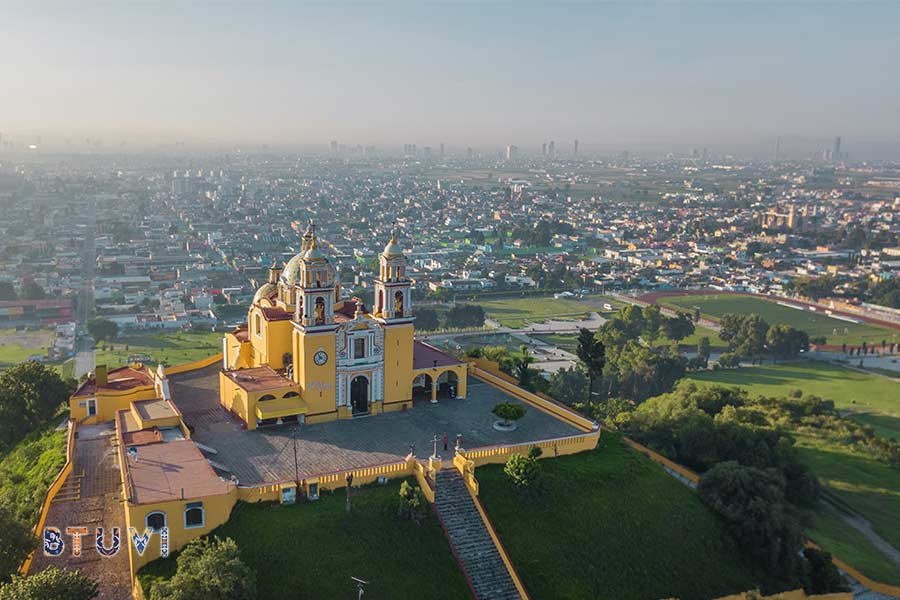 The Sanctuary of Our Lady of Remedies crowns the Great Pyramid of Cholula. Photo: BTUVI.
Mexico City offers an extraordinary concentration of museums, archaeological sites, art, and history. But some of Mexico's most fascinating cultural experiences lie beyond the capital.
A day trip to Puebla and Cholula from Mexico City reveals a different side of the country—one where ancient sacred spaces, spectacular churches, colonial architecture, and living traditions meet in the same landscape.
For many international travelers, Cholula is associated with its famous Great Pyramid, while Puebla is known for its beautiful historic center and traditional cuisine. Yet both destinations have stories that go far beyond their most recognizable attractions.
The real fascination begins when you understand how these places connect: how an ancient ceremonial center became part of a changing religious landscape, how European architectural traditions were transformed in Mexico, and how the country's history continues to shape its cities.
If you enjoy discovering the meaning behind the places you visit, Puebla and Cholula deserve a place in your Mexico City itinerary.
Why Visit Puebla and Cholula Together?
Although they are close to one another, Puebla and Cholula offer two distinct cultural experiences.
Cholula invites you to discover one of ancient Mesoamerica's great religious and urban centers. Its archaeological remains, churches, and surrounding communities reveal centuries of cultural transformation.
Puebla, founded in 1531, developed into an important city connecting Mexico's central highlands with the Gulf Coast. Its historic center is celebrated for its architecture, religious art, colorful tilework, and beautifully preserved urban character.
The Historic Centre of Puebla was inscribed on the UNESCO World Heritage List in 1987, recognizing its exceptional architectural and historical significance.
Visiting these destinations together allows you to experience different chapters of Mexican history in one day, from the pre-Hispanic world to the colonial period and the development of modern Mexico.
1. The Great Pyramid of Cholula: More Than an Ancient Monument
At first glance, the Great Pyramid of Cholula may surprise visitors.
Unlike the monumental stone structures commonly associated with Teotihuacan, much of Cholula's enormous pyramid resembles a natural hill. Rising above it is the Sanctuary of Our Lady of Remedies, one of the region's most recognizable landmarks.
But what appears to be a hill is actually the result of centuries of construction.
Known as Tlachihualtépetl, often translated as "handmade mountain," the Great Pyramid developed through successive building phases. According to Mexico's National Institute of Anthropology and History (INAH), its vast base extends approximately 450 meters along each side.
The structure reflects the importance of Cholula as an ancient religious, commercial, and cultural center.
A sacred place through changing centuries
What makes Cholula especially fascinating is not simply the scale of its pyramid.
It is the continuity of human attachment to this landscape.
Long before the Spanish arrived, Cholula was a major ceremonial center and pilgrimage destination. Religious traditions, economic networks, and cultural relationships connected it with other parts of Mesoamerica.
During the colonial period, a Catholic sanctuary was constructed on top of the ancient pyramid.
Today, the sanctuary and the archaeological remains create one of Mexico's most remarkable historical landscapes: different expressions of religious life occupying the same significant place across centuries.
Understanding these layers makes the experience much more meaningful than simply taking a photograph of the church above the pyramid.
And on a clear day, the surrounding landscape may offer dramatic views toward the Popocatépetl volcano.
Travel insight: Archaeological access, including any underground tunnels, can change because of conservation and safety work. Check the current visiting arrangements before your trip.
2. Santa María Tonantzintla: A Church That Tells a Cultural Story
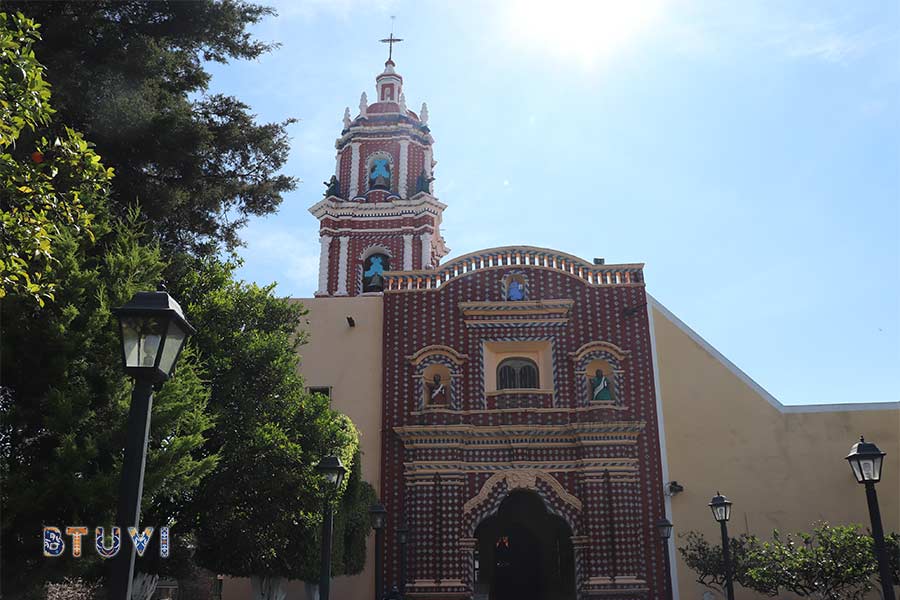 Santa María Tonantzintla, near Cholula. Photo: BTUVI.
One of the most captivating experiences near Cholula is the Church of Santa María Tonantzintla.
Its interior offers an extraordinary display of ornamentation, with dense decorative forms, religious imagery, and artistic details that reward careful observation.
The church is often discussed as an exceptional example of indigenous Baroque expression within the religious architecture of colonial Mexico.
What makes this place memorable is not simply its visual richness.
It invites visitors to consider how artistic traditions, religious teachings, and local cultural expression interacted during the colonial period.
Look closely at the decorative figures and the relationships between the different elements. What first appears to be an overwhelming collection of details begins to reveal an elaborate visual language.
You do not need to be an art historian to appreciate Tonantzintla.
You only need curiosity—and the opportunity to understand what you are looking at.
3. San Francisco Acatepec: A Masterpiece of Color and Architecture
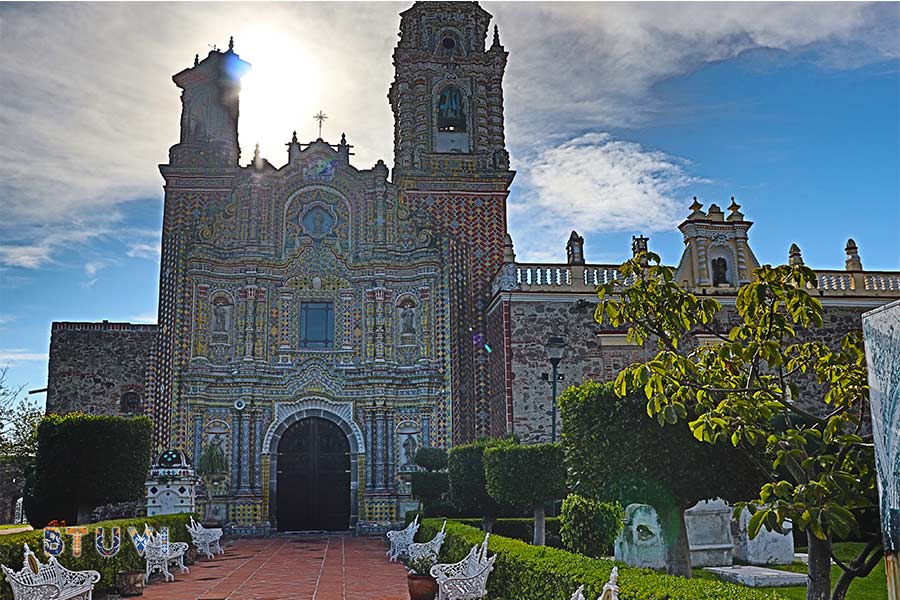 San Francisco Acatepec is known for its richly tiled facade. Photo: BTUVI.
Another remarkable church near Cholula is San Francisco Acatepec.
Its exterior is particularly striking.
The facade uses richly colored ceramic tiles to create an elaborate decorative composition. Rather than relying only on carved stone, the building presents a vibrant expression of religious architecture.
It is an excellent introduction to the creative possibilities of colonial Mexican art.
Here, architecture becomes more than construction. It becomes a visual statement about craftsmanship, faith, artistic exchange, and regional identity.
Together, Tonantzintla and Acatepec demonstrate why the cultural heritage of Puebla cannot be understood simply as a copy of European architecture.
Local traditions, materials, and artistic decisions helped create something distinctive.
4. Puebla's Historic Center: A UNESCO World Heritage Treasure
After discovering Cholula and its surrounding churches, Puebla offers another impressive chapter of the journey.
The city's Historic Center is one of Mexico's outstanding architectural ensembles.
Its streets reveal an urban landscape of churches, historic residences, courtyards, decorative facades, and colorful ceramic tiles.
UNESCO recognizes Puebla for the way European and American artistic influences contributed to a distinctive regional interpretation of Baroque architecture.
But Puebla should not be approached only as a collection of beautiful buildings.
Each street can reveal something about the city's commercial importance, religious institutions, artistic traditions, and everyday history.
Puebla Cathedral
The Cathedral of Puebla is among the city's most important architectural landmarks.
Its scale and design reflect the political and religious importance of Puebla during the colonial era.
A visit offers an opportunity to understand the role of monumental religious architecture in the development of New Spain.
The Rosary Chapel: An Extraordinary Baroque Interior
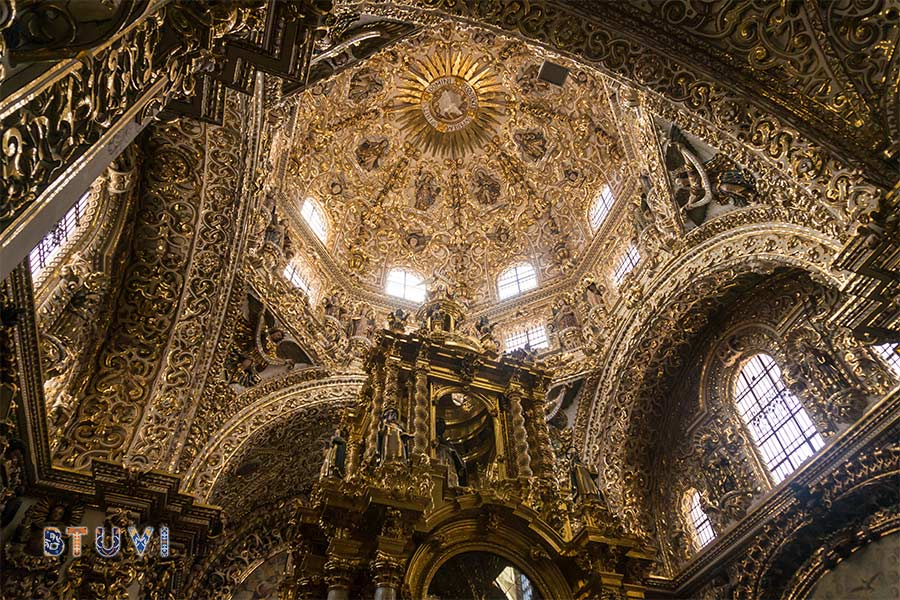 The ornate interior of the Rosary Chapel in Puebla. Photo: BTUVI.
Located within the Church of Santo Domingo, the Chapel of the Rosary—Capilla del Rosario—is one of the most memorable artistic spaces in Puebla.
Its elaborate ornamentation, gilded surfaces, and intricate decorative program create an extraordinary expression of Mexican Baroque art.
The chapel rewards more than a quick look.
Its artistic richness reflects a world in which architecture, painting, sculpture, and religious symbolism were designed to work together.
A visitor may initially be impressed by the abundance of gold and decoration. Yet understanding the artistic purpose behind these details creates a much deeper experience.
This is one of those places where explanation transforms admiration into understanding.
5. Puebla and Cinco de Mayo: The History Behind the Celebration
Puebla is also closely connected with one of Mexico's best-known historical dates: May 5.
International visitors, particularly from the United States, often recognize Cinco de Mayo as a Mexican celebration. However, it is sometimes confused with Mexico's Independence Day, which is celebrated on September 16.
Cinco de Mayo commemorates the Mexican victory over French forces at the Battle of Puebla on May 5, 1862.
The forts of Loreto and Guadalupe played an important role in the battle, during which Mexican forces under General Ignacio Zaragoza defeated the invading army.
Today, the area surrounding these historic fortifications offers an opportunity to understand an important moment in Mexico's struggle to defend its sovereignty.
The significance of this event becomes clearer when connected to the broader history of nineteenth-century Mexico, including political conflict, foreign intervention, and the formation of the modern republic.
For visitors interested in history, Puebla offers a particularly meaningful perspective on Cinco de Mayo.
6. Discover Puebla Through Its Food and Traditions
Culture is not limited to archaeological sites, churches, or museums.
It is also present in what people cook, share, celebrate, and preserve.
Puebla is one of Mexico's great culinary destinations, with dishes closely associated with the region's cultural identity.
Among its best-known specialties are:
- Mole poblano: A complex traditional sauce associated with Puebla's culinary heritage.
- Chiles en nogada: An iconic seasonal dish featuring a stuffed poblano pepper, walnut sauce, and pomegranate.
- Cemitas poblanas: A distinctive regional sandwich that reflects Puebla's everyday food culture.
Food provides another way to explore Mexico's historical relationships between ingredients, traditions, and regional identities.
Even a lunch break can become part of the cultural experience when you understand the stories behind local dishes.
7. Can You Visit Puebla and Cholula in One Day from Mexico City?
Yes. A Puebla and Cholula day trip from Mexico City is possible, particularly when transportation and the visiting route are planned in advance.
However, it should be treated as a full-day excursion rather than a quick outing.
Travel times depend on road conditions and traffic, while the time available at individual attractions can vary according to opening hours, access restrictions, and the pace of the visit.
A well-planned cultural excursion can combine several highlights, such as the Great Pyramid of Cholula, the churches of Tonantzintla and San Francisco Acatepec, Puebla's Historic Center, the Rosary Chapel, and the historic forts.
The important consideration is not how many places you can fit into one itinerary.
It is whether you have enough time to appreciate their stories.
For travelers who value architecture, archaeology, history, and cultural interpretation, a carefully organized day can be far more rewarding than rushing between attractions.
8. Why Explore Puebla and Cholula with a Private Guide?
Traveling independently can be enjoyable, especially if you prefer to wander, take photographs, and explore at your own pace.
But Puebla and Cholula offer something particularly valuable to culturally curious travelers: places whose meaning is not always immediately visible.
A church may appear beautiful without revealing the artistic traditions behind its decoration.
An archaeological site may appear impressive without explaining the people who built it.
A historic fortress may offer a memorable view without telling the story of the battle that took place there.
A professional private guide can help connect these experiences.
Instead of seeing unrelated attractions, you begin to recognize a broader cultural narrative.
For international visitors, professional interpretation can also make complex historical subjects easier to understand without reducing them to a list of names and dates.
Explore with Cleyber Can, a Certified Private Guide in Mexico City
Cleyber Can is a certified private tour guide in Mexico City who specializes in cultural experiences focused on Mexican history, art, archaeology, and meaningful places.
His approach emphasizes storytelling, historical interpretation, and helping travelers understand the significance of what they see.
For travelers considering a day trip beyond Mexico City, Cleyber offers a private Puebla and Cholula experience that brings together major archaeological, architectural, and historical landmarks.
The experience includes private transportation from your Mexico City hotel, professional guiding, and an itinerary connecting Cholula with important cultural attractions in Puebla.
The published itinerary allows approximately ten hours for the excursion, plus an hour for lunch. Food and drinks are not included.
If you are looking for a private guide in Mexico City who can also introduce you to the cultural heritage of Puebla and Cholula, this experience offers an organized way to explore the region with historical context.
Explore the Private Puebla Tour with Cleyber Can
You can also learn more about why hiring a private guide in Mexico City can transform your cultural experience.
Frequently Asked Questions About Puebla and Cholula
Is Puebla worth a day trip from Mexico City?
Yes, especially for travelers interested in Mexican history, colonial architecture, religious art, and traditional food. Its UNESCO-listed historic center provides a cultural experience that differs considerably from Mexico City.
Can you visit Puebla and Cholula on the same day?
Yes. The destinations are close enough to combine in a full-day excursion. A planned route helps you make the most of your time, although the number of places visited depends on travel conditions, access, and your preferred pace.
What is special about the Great Pyramid of Cholula?
The Great Pyramid is remarkable for its enormous scale, multiple construction phases, and historical importance as part of an ancient ceremonial center. The Catholic sanctuary above the archaeological structure adds another layer to its cultural story.
What should I wear for a Puebla and Cholula day trip?
Comfortable walking shoes are recommended, along with sun protection and clothing suitable for changing weather. Some areas involve uneven ground or uphill walks. Religious sites may also require visitors to respect specific access rules.
Is a private Puebla tour suitable for English-speaking visitors?
Yes. Cleyber Can offers private cultural experiences in English and Spanish, helping international travelers understand the historical background, architecture, and cultural meaning of the places they visit.
Final Thoughts: Discover the Stories Beyond the Famous Pyramid
Puebla and Cholula offer much more than beautiful photographs and famous landmarks.
They reveal how civilizations, artistic traditions, religious beliefs, historical conflicts, and everyday culture have shaped Mexico across centuries.
From the ancient sacred landscape of Cholula to the spectacular Baroque art of Puebla, these destinations invite travelers to explore Mexico from a different perspective.
And often, the most memorable part of the journey is not discovering a place for the first time.
It is finally understanding why that place matters.
Ready to discover Puebla and Cholula beyond the surface?
Plan your private cultural experience with Cleyber Can — a certified private guide in Mexico City who can help you explore the history, art, and fascinating stories behind these extraordinary places.