
Why Bellas Artes matters so much
Few places in Mexico City capture the country’s cultural identity as powerfully as Palacio de Bellas Artes. It is not just a beautiful building in the historic center. Official Mexico City tourism information describes it as one of the most prominent buildings in the country and the major fine arts institution for Mexico as a whole. It is also the headquarters of the Instituto Nacional de Bellas Artes y Literatura (INBAL) and home to some of the country’s most important artistic institutions, including the National Theater Company, the National Dance Company, the National Symphony Orchestra, the National Opera Company, and the Ballet Folklórico de México. Its main hall accommodates around 1,700 guests, which shows that this is not a symbolic venue only. It remains a living center of performance and culture.
For foreign travelers, that matters because Bellas Artes offers a rare combination of beauty, history, and active cultural life. Some landmarks are impressive mainly from the outside. Others are valuable only if you already know a lot about art or architecture. Bellas Artes works differently. It is visually unforgettable even at first glance, but it also rewards deeper attention. It helps visitors understand that Mexico City is not only ancient and colonial. It is also modern, artistic, and intellectually ambitious. That broader identity is part of what makes the palace such an essential stop for anyone trying to understand the city beyond surface-level tourism.
A landmark at the heart of Mexico City
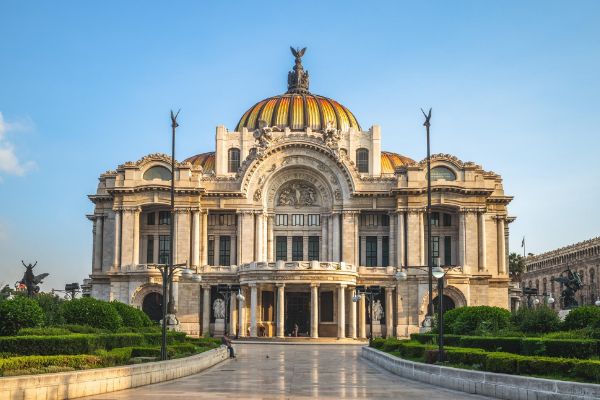
One reason Palacio de Bellas Artes Mexico City leaves such a strong impression is its location. It stands in the Historic Centre of Mexico City, one of the most symbolically charged areas in the country. UNESCO includes Bellas Artes among the important 19th- and 20th-century public buildings that contribute to the value of the Historic Centre of Mexico City and Xochimilco World Heritage Site. In other words, Bellas Artes is not just a famous building somewhere in the city. It is part of one of the most historically significant urban spaces in the Americas.
Its position beside Alameda Central also gives it a special urban presence. Official palace history notes that by 1901 it had already been decided that the new national theater would be located next to Alameda Central. That decision helped place the building in a highly visible and culturally strategic part of the city, where it still acts as a bridge between public space, historic downtown, and artistic life. For visitors, this makes Bellas Artes especially rewarding because it fits naturally into a larger day exploring the historic center, Alameda, nearby streets, and other important landmarks.
The long history behind the building
The story of Bellas Artes is one of the reasons the building feels so meaningful. Official INBAL history explains that its immediate predecessor was the old National Theater, once considered the most important venue of its kind in Mexico’s artistic and cultural life during the second half of the nineteenth century. At the beginning of the twentieth century, rather than simply renovating it, authorities chose to demolish it and build a new structure that would match the city’s urban and cultural growth. Construction began in 1904 with the goal of finishing in four years, but budget problems, technical issues, and later the upheaval of the Mexican Revolution delayed the project.
The official history also explains that architect Adamo Boari returned to Europe in 1916, by which point almost all of the exterior had been completed except for the dome covering. Progress slowed dramatically for years, and only later, under architect Federico E. Mariscal, was the project pushed toward completion. By the early 1930s, the vision of the building evolved: it was no longer conceived only as a national theater, but as a broader artistic institution that could house multiple museums and serve a national cultural role. This was the moment when the name changed from Teatro Nacional to Palacio de Bellas Artes. The building finally opened in 1934.
For travelers, this layered history adds a lot to the experience. Bellas Artes is not simply a monument from one era. It is a building shaped by both the late Porfirian period and post-revolutionary Mexico. Official palace history explicitly says that two important periods of national history define it: the regime of Porfirio Díaz and the Mexican Revolution. That alone helps explain why the building feels larger than its façade. It carries within it a story about ambition, interruption, reinvention, and national identity.
Why the architecture makes such a strong impression
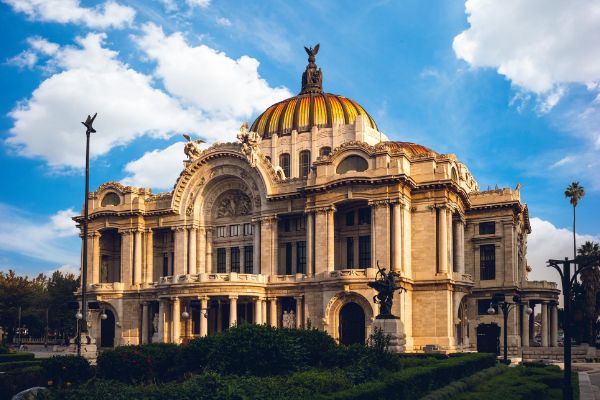
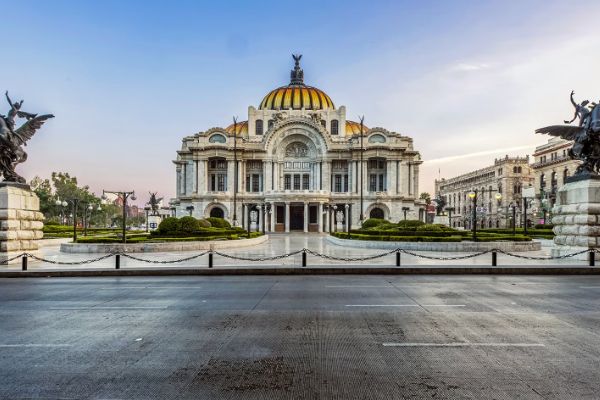
One of the biggest reasons Bellas Artes is so iconic is its architecture. Mexico City’s official tourism guide describes it as principally Art Nouveau on the outside and Art Deco on the inside, a combination that immediately makes it stand out from many other historic buildings in the city. The exterior, designed by Adamo Boari, uses white Carrara marble and includes sculptural details, decorative symbolism, and a dramatic sense of monumentality. The palace plaza also features the well-known Pegasus sculptures, while other elements such as the main entrance sculpture program and the glass-covered roof add to its visual identity.
The interior continues that impact in a different language. According to the same official tourism description, the inside was completed primarily in Art Deco forms under Federico Mariscal. The halls incorporate modern decorative design while also including pre-Hispanic motifs such as serpent heads and references to deities like Chaac and Tlaloc. This makes the palace especially interesting for foreign visitors, because the building does not feel like a copy of European elegance transplanted into Mexico. It feels like a place where international styles and Mexican cultural references were consciously brought together.
Another remarkable feature is the famous glass curtain in the main theater. Official city tourism information describes it as a folding panel made of nearly a million pieces of iridescent colored glass produced by Tiffany in New York, weighing around 24 tons and remaining unique in the world. The curtain depicts the volcanoes Popocatépetl and Iztaccíhuatl, adding yet another layer of Mexican symbolism to the building. Details like this are part of why Bellas Artes feels unforgettable even to travelers who do not usually consider themselves architecture lovers.
The murals are one of the biggest reasons to visit
If the architecture draws people in, the murals often become the reason they remember the visit so vividly. The Museo del Palacio de Bellas Artes officially states that it houses an important permanent collection of murals created by some of the most prominent Mexican muralists of the twentieth century. The museum’s permanent mural collection includes works by Diego Rivera, José Clemente Orozco, David Alfaro Siqueiros, Jorge González Camarena, Rufino Tamayo, and Manuel Rodríguez Lozano. The museum describes this collection as bringing together, in one place, more than thirty years of mural history.
That matters because Bellas Artes is one of the best places in Mexico City to understand the power of Mexican muralism without needing to travel across multiple buildings first. Official tourism information notes that the upper levels include murals by Orozco, Siqueiros, Rivera, González Camarena, Roberto Montenegro, and Rodríguez Lozano, while the first floor includes works by Rufino Tamayo. This turns the palace into much more than a performance venue. It becomes a concentrated visual introduction to the way modern Mexico used public art to interpret history, politics, labor, identity, and national memory.
For foreign travelers, this is especially valuable. Many people arrive in Mexico knowing the names Diego Rivera or Siqueiros, but they have not yet seen how muralism functions in architectural space. At Bellas Artes, the murals are not isolated objects. They are part of a building that already carries national significance. This makes the experience much stronger. Instead of seeing art as something separate from Mexican history, visitors begin to understand how art became one of the ways Mexico explained itself in the twentieth century.
More than a museum, more than a theater
One reason Bellas Artes is so rewarding is that it does not fit neatly into a single category. It is not only a museum, and it is not only a theater. Official Mexico City information presents it as a major national arts institution, while INBAL’s palace history makes clear that the project eventually took shape as a space intended to house several museums as well as broader artistic activity. That hybrid identity remains part of its appeal today. Visitors can admire the building, explore the museum, view murals, and in some cases attend a performance, all within the same landmark.
This flexibility is one reason Bellas Artes works so well for first-time visitors. Some travelers want architecture. Others are drawn to painting, history, or live performance. Bellas Artes can offer all of those things at once. It also helps explain why the site has such strong symbolic weight in Mexico City. It is one of the places where the nation’s artistic life, historical storytelling, and public identity intersect in a visible and accessible way.
Why foreign travelers connect with it so quickly
Foreign visitors often connect with Bellas Artes almost immediately because it is easy to appreciate on more than one level. On a purely visual level, the building is striking. It stands out because of its marble, dome, scale, and position near Alameda Central. On a cultural level, it quickly reveals that Mexico City is not defined only by archaeology or colonial history. Bellas Artes introduces travelers to another side of the city: one shaped by opera, dance, muralism, modern architecture, and national cultural institutions. Official tourism information reinforces this by presenting the palace as the country’s principal fine arts venue and by highlighting the major companies based there.
It also helps that Bellas Artes is approachable. Even visitors with little background knowledge can enjoy the building from the outside, recognize the importance of the interior spaces, and respond emotionally to the murals or a performance. At the same time, travelers who want more depth find plenty to explore in the building’s history, architecture, and cultural role. That balance is rare. Some landmarks are easy to admire but shallow. Others are rich but intimidating. Bellas Artes manages to be both accessible and profound.
Practical things visitors should know
For travelers planning a visit, the Museo del Palacio de Bellas Artes currently lists opening hours as Tuesday through Sunday from 10:00 a.m. to 5:30 p.m., with the museum closing at 6:00 p.m. The same official information notes that the final access time is 5:30 p.m.. Because Bellas Artes is both a museum and a performance venue, it is wise to distinguish between museum hours and performance schedules. The official palace site separately lists box office hours that vary by day and extend later when there is a function scheduled.
Location is another advantage. Official palace history places the building at Avenida Juárez and Eje Central Lázaro Cárdenas in the historic center, beside Alameda Central. That makes it easy to combine with nearby places such as the Alameda, Madero Street, the Zócalo area, or a broader downtown cultural route. For many visitors, Bellas Artes fits naturally into a half-day or full-day exploration of central Mexico City.
A final practical point is that Bellas Artes should not be rushed. Many travelers stop only for exterior photos and move on. But the palace is one of those places where going inside makes a major difference. The murals, the interior design, and the broader cultural context are essential parts of the experience. Even a relatively short visit becomes much more meaningful once you move beyond the façade.
Why a private guide can improve the experience
A private guide can make Bellas Artes much more meaningful because the building contains multiple stories at once. On your own, it is easy to appreciate the architecture and maybe recognize a few muralists’ names. With a guide, the palace becomes easier to read as a cultural statement. A guide can explain why the building reflects both Porfirian ambition and post-revolutionary reinvention, why the combination of Art Nouveau and Art Deco matters, how the murals relate to Mexican political and artistic history, and how Bellas Artes fits into the broader story of the historic center. All of those layers are present in the official sources, but they become more memorable when connected into one clear narrative.
Guided interpretation is also valuable because Bellas Artes connects naturally to other nearby places. A strong visit here can lead into conversations about muralism, Alameda Central, the historic center, the National Palace murals, or the broader role of public art in modern Mexico. That makes Bellas Artes an ideal stop within a larger cultural route rather than a single isolated attraction. For travelers who want to understand Mexico City more deeply, that kind of connection is often what makes the experience unforgettable.
Final thoughts
Palacio de Bellas Artes Mexico City is one of the city’s most iconic cultural landmarks because it brings together architecture, national history, muralism, live performance, and artistic identity in one extraordinary place. It is part of the historic center’s world-recognized heritage, it carries a long and complex history of construction and reinvention, and it remains one of the most important artistic venues in the country today. That is why it continues to impress both first-time visitors and people who return to Mexico City again and again.
For travelers who want more than just a quick photo of a famous building, Bellas Artes offers one of the richest cultural experiences in the capital. It helps you see Mexico City not only as ancient and historic, but also as creative, intellectual, and deeply alive. To explore it with more context and a more personal perspective, discover the city with Cleyber Can Guide at cleybercan.travel.