Why this part of the city matters so much
The Mexico City Historic Center is special because it is not just one attraction or one monument. It is an entire urban core where centuries of history are layered together in a way that is unusually visible. The official Mexico City visitor guide describes Centro Histórico as the area with the largest concentration of museums, cultural sites, and points of interest in the entire city, and it also presents it as one of the best introductions a traveler can have to Mexico City. That is exactly what makes it so valuable for foreign visitors: it gives you architecture, archaeology, religion, politics, art, and everyday city life in one walkable area.
For a first-time visitor, that density of meaning changes everything. In many cities, the “historic center” is beautiful but limited to one period. In Mexico City, the historic center feels larger than a postcard version of the past. It is a place where pre-Hispanic memory, colonial ambition, republican symbolism, and modern public life all remain visible at once. UNESCO highlights this layered character by noting that the city was built by the Spanish in the sixteenth century on the ruins of Tenochtitlan, the old Aztec capital, and that the area still preserves identified Aztec temple remains, a monumental cathedral, and important later public buildings such as the Palacio de Bellas Artes.
A place built on top of Tenochtitlan
One of the deepest reasons the Mexico City Historic Center feels so powerful is that it literally stands on top of an earlier world. UNESCO’s official description makes this clear: colonial Mexico City was built over Tenochtitlan, the Mexica capital. That means when foreign travelers walk through the center today, they are not simply seeing a colonial district. They are moving through a place where one civilization was imposed on top of another, but where the older layers never completely disappeared.
This becomes especially clear at Templo Mayor. INAH describes it as the center of Mexica religious and political life, standing in the heart of modern Mexico City and dedicated to Tlaloc and Huitzilopochtli. The archaeological remains and the museum reveal that this was not a minor shrine tucked away in a side street. It was one of the most important sacred and political points in pre-Hispanic Mexico. The Templo Mayor Museum, inaugurated in 1987, was created specifically to display findings from the archaeological zone and to show the political, military, and aesthetic relevance of the city that dominated Mesoamerica before the Spanish conquest.
That contrast is one of the most fascinating things a traveler can experience here. In very few places can you stand near the remains of a Mexica ceremonial center and then immediately look up at colonial-era stonework, civic buildings, and busy streets full of modern life. The official “Zócalo & Templo Mayor Walking Route” from Mexico City tourism even describes this area as one of the surest ways to get an initial introduction to both modern Mexico City and ancient Tenochtitlan. That is exactly why the district feels so intellectually rich from the very first visit.
The Zócalo is more than a square
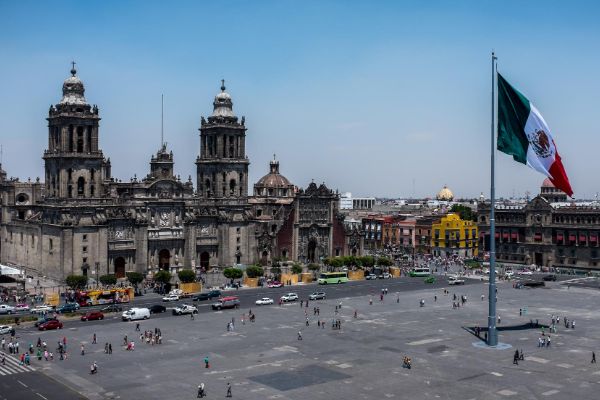
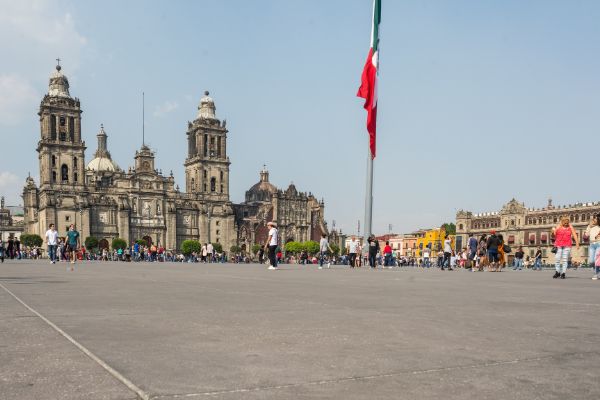
Most foreign travelers begin with the Zócalo, and that makes sense. It is not only the physical center of the district, but also one of the strongest symbolic spaces in the country. The official Mexico City tourism site says the Zócalo area is the center of the city and, in many ways, the center of Mexico as well. Around it are some of the first and most important places visitors encounter: the Metropolitan Cathedral, Templo Mayor, the National Palace, and other major historic buildings.
What makes the Zócalo so memorable is scale and meaning together. It is vast, open, and public, but it is also framed by buildings that represent different chapters of Mexican history. The official page for the National Palace emphasizes that the palace has long served official and civic functions of the Mexican state and that it dominates the entire east side of the square. Inside, it also houses Diego Rivera murals, linking the political heart of the country with one of the most important visual narratives of Mexican history.
The Zócalo is also where travelers begin to understand that Mexico City’s historic center is not frozen in time. It is still a living civic stage. Ceremonies, demonstrations, official commemorations, tourism, and everyday local life all continue there. That ongoing public energy is part of what makes the space feel so different from a museum plaza. It is historical, but it is also active, national, and contemporary.
Why the landmarks feel so powerful
The power of the district comes from the fact that its landmarks are not decorative. They represent major cultural institutions and turning points in history. The Metropolitan Cathedral, for example, is not just a beautiful church. UNESCO identifies the cathedral as one of the defining monumental elements of the site, and the official Mexico City tourism page describes it as a high point of vice-regal and colonial art, architecture, and craftsmanship. Construction began in the mid-sixteenth century and was completed in 1813, incorporating Renaissance, Baroque, and Neoclassical elements into a single monumental structure.
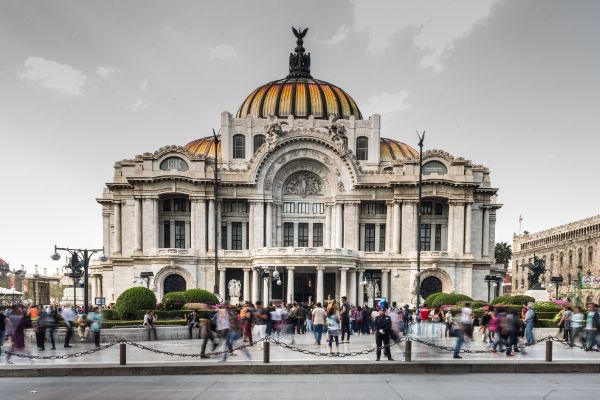
A short distance away, the Palacio de Bellas Artes adds another layer to the story. Official Mexico City tourism material describes it as one of the country’s most prominent buildings and the major fine arts institution for Mexico as a whole. It houses major national artistic bodies, including the National Theater Company, the National Dance Company, the National Symphony Orchestra, the National Opera Company, and the Ballet Folklórico de México. Official city material also notes that Bellas Artes is difficult to place neatly into one historical period because it presents Art Nouveau on the outside and Art Deco on the inside, making it an especially vivid example of how the center mixes styles and eras.
This is why a walk through the historic center can feel emotionally bigger than expected. You are not moving past anonymous old buildings. You are walking among structures that still carry enormous symbolic weight. One building represents the colonial church, another the Mexica sacred precinct, another the seat of national power, and another the country’s leading fine arts institution. Few city centers compress that much historical meaning into such a concentrated area.
It is not just history, it is still alive
Another reason the center feels special is that it remains deeply active. The official city guide presents it not as a dead monument district but as a place full of routes, directions, neighborhoods, temples, museums, parks, and related walking experiences branching west, east, north, and south from the Zócalo. That tells you something important: the center is not one isolated square surrounded by old façades. It is an entire living network of streets and experiences.
That living quality matters because it changes the mood of the visit. Travelers can move from ceremonial spaces to noisy pedestrian streets, from sacred architecture to civic plazas, from archaeological remains to performance venues. This constant shift in atmosphere is part of what makes the center so rewarding. You are not just looking at history behind ropes. You are experiencing a district where history still shapes the rhythm of everyday life.
It also helps explain why many people return to the area more than once during the same trip. A traveler may visit first for the Zócalo, return for Templo Mayor, then come back again for Bellas Artes, Madero Street, or a walking route through the surrounding area. The historic center supports that kind of repeated discovery because it is large, layered, and constantly changing depending on the time of day and the focus of the visit.
Why foreign travelers connect with it so quickly
Foreign travelers often connect with the historic center very quickly because it explains Mexico in a direct visual way. You do not need to be an academic to understand that something extraordinary happened here. Even without reading deeply, you can see the overlap of civilizations, the scale of the institutions, and the national significance of the surroundings. The official city guide even notes that Centro Histórico is easy to navigate and makes a great introduction to the city, which is important for travelers arriving in such a large capital for the first time.
There is also a practical reason it works so well: the area gathers many of the things international visitors care about most in one place. Archaeology, architecture, museums, iconic public spaces, and symbolic landmarks are all close together. That concentration lowers the barrier to cultural understanding. Instead of needing several separate excursions to begin understanding Mexico City, travelers can start building that understanding in a single district.
For English-speaking visitors especially, the area offers a strong starting point for the rest of the trip. Once you understand the relationship between the Zócalo, Templo Mayor, the Cathedral, the National Palace, and Bellas Artes, many other places in the city make more sense. The center does not explain everything, but it gives the traveler a framework. And that framework is often what turns curiosity into genuine cultural appreciation.
How to explore the area in a smarter way
The smartest way to visit the Mexico City Historic Center is to avoid treating it like a checklist of disconnected stops. The official tourism material already organizes the area through themed walking routes, including the Zócalo & Templo Mayor Walking Route and the Alameda Central – Av. Madero Walking Route. That is a useful clue for travelers: the center works best when explored as a sequence of connected places rather than as random pins on a map.
A smarter visit also means accepting that one walk cannot “finish” the historic center. There is simply too much there. Instead of trying to see everything at once, it is usually better to focus on the story of the place. Begin with the Zócalo, understand why Templo Mayor matters, appreciate the Cathedral and the National Palace, and then expand toward Bellas Artes and the surrounding streets. That approach tends to create a much stronger memory than rushing through the area for photos alone.
Why a private guide changes the experience
The historic center is impressive without explanation, but it becomes far more meaningful with good interpretation. This is because the district is full of visual overlaps that can be easy to miss if you do not know what you are looking at. A private guide can explain why the square matters politically, why Templo Mayor is so important archaeologically, how the Cathedral reflects colonial power, and why Bellas Artes belongs in the same larger story even though it represents a later moment in Mexico’s cultural life. Those connections are what transform the area from “beautiful downtown” into one of the most important cultural spaces in the country.
A guided visit also helps foreign travelers use their time more intelligently. Because the district is dense, it is easy to walk a lot and still miss the deeper meaning of what is around you. A well-structured private experience can turn that same walk into a coherent story about Tenochtitlan, conquest, colonial Mexico, public power, religion, and national identity. In a place as layered as the Mexico City Historic Center, that kind of context is often the difference between a pleasant visit and an unforgettable one.
Final thoughts
What makes Mexico City’s historic center so special is not only its beauty, but its depth. It is one of those rare places where ancient ruins, colonial architecture, national institutions, and living public culture coexist in a single urban landscape. UNESCO recognizes that exceptional value, and the official city and heritage sources make it clear why the district remains one of the most important places to begin understanding Mexico City.
For travelers who want more than surface-level sightseeing, the Mexico City Historic Center offers one of the most rewarding experiences in the country. It is a place to walk slowly, observe carefully, and connect the city’s past with its present. To explore it with more context, more meaning, and a more personal perspective, discover Mexico City with Cleyber Can Guide.