Why Coyoacán feels so different
For many foreign travelers, Coyoacán Mexico City feels like a surprise. Even after visiting the grand avenues, major museums, and monumental spaces of the capital, arriving in Coyoacán often feels like stepping into a calmer, more intimate side of the city. The official Mexico City tourism site describes Coyoacán as a place whose identity was forged long before it became part of the modern metropolis and emphasizes its long separate character, rooted in older settlements, local traditions, and a distinctive urban personality. The same official tourism content presents the Historic Center of Coyoacán as an influential and important part of the whole city, one whose streets and gardens seem to shape the very idea many people have of Mexico City itself.
That helps explain why Coyoacán leaves such a strong impression. It is not only “pretty” or “bohemian,” although many visitors describe it that way. What makes it special is that it preserves a sense of neighborhood life, layered history, and cultural intimacy that can feel very different from the scale and intensity of central Mexico City. Travelers come for famous places like the Frida Kahlo Museum, but they often discover that the real attraction is the atmosphere of the area itself: tree-lined streets, plazas, colonial traces, local food, and a pace that invites people to walk more slowly and pay attention.
A place with a much older history than many visitors expect
One of the most interesting things about Coyoacán is that its history goes much deeper than many visitors realize. Official Mexico City tourism explains that Coyoacán was once a key city under the Tepanec empire, before the rise of the Mexica, and that its name comes from Nahuatl, commonly interpreted as “place of the owners of coyotes.” The same source also notes that Coyoacán later became the first New Spanish city council, officially founded in 1521, which immediately gives the district an important place in the transition from the pre-Hispanic world to colonial Mexico.
Official borough history adds even more depth. The Coyoacán borough’s cultural history page explains that the area already existed long before the Mexica founded Tenochtitlan and points to archaeological remains in nearby places such as Cuicuilco and Copilco as evidence of very early settlement in the region. Meanwhile, the Mexico City tourism page on Coyoacán Original Settlements states that the area has been inhabited for at least 2,500 years and that several original neighborhoods still preserve old street patterns and traces of a much earlier past. This matters because it shows that Coyoacán is not simply a picturesque colonial quarter. It is a place where very long historical continuity is still visible in urban form and cultural memory.
For foreign travelers, this older background adds real value to the visit. Without it, Coyoacán can seem like a beautiful place to stroll, have coffee, and take photos. With it, the neighborhood becomes more meaningful. It starts to feel like one of those places where the story of Mexico can be read at a human scale: not only through monuments, but through streets, settlements, traditions, and the persistence of local identity.
The charm of the historic center
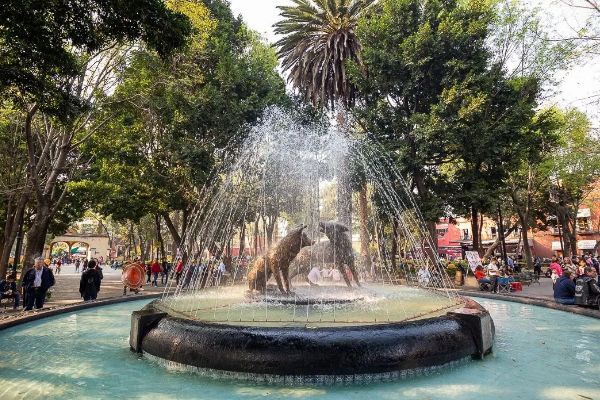
The Historic Center of Coyoacán is one of the main reasons the area is so beloved. Mexico City tourism describes it as a core ensemble where Plaza Hidalgo and Jardín Centenario preserve the charm of the sixteenth century. The same official source notes that these central spaces are framed by the Parish of San Juan Bautista, the arches of the old city hall, the well-known Fountain of the Coyotes, and the shade of mature trees that make the district feel welcoming and distinctive.
What makes this center so memorable is that it feels both historic and lived-in. It is not a museum district emptied of daily life. Official city tourism describes the area as a place where visitors quickly move beyond the Frida Kahlo Museum and discover central gardens, cobbled paths, nearby streets, markets, trees, and avenues that create an attractive atmosphere in almost every direction. That description feels accurate because the pleasure of Coyoacán is not limited to one building or one plaza. It comes from wandering and noticing how the neighborhood holds together as a complete environment.
For foreign visitors, this is often part of the neighborhood’s charm. The center is easy to enjoy even without specialized knowledge. You can sit in the plaza, listen to the sounds around you, watch local life move by, and feel that you are in a place with character rather than in a generic tourist zone. That quality is harder to create than it looks, and it is one of the reasons Coyoacán keeps drawing people back.
Why Frida Kahlo made Coyoacán famous worldwide
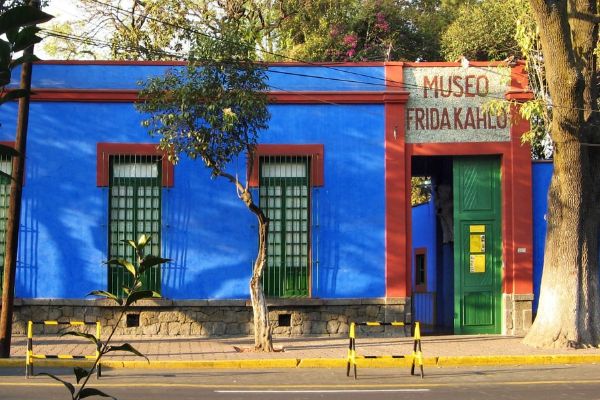
It would be impossible to talk about Coyoacán without talking about Frida Kahlo. The official Mexico City tourism guide calls the Frida Kahlo Museum, also known as Casa Azul, a must-see corner of Coyoacán where the essence of the artist remains intact. It notes that Frida was born there, lived much of her life there with Diego Rivera, and died there, and that visitors can see objects that bring them closer to her personal world, including brushes, her original easel, iconic dresses, and her collection of popular art.
The museum’s own official site confirms its hours and location and shows just how important it remains as an active cultural destination. As of June 2026, the museum lists opening hours of Tuesday 10:00–18:00, Wednesday 11:00–18:00, and Thursday to Sunday 10:00–18:00, with Monday closed. The official visit page also states that there are no in-person ticket sales, which is a very useful practical detail for travelers planning a visit. General admission is currently listed at 320 MXN, with different reduced rates for specific groups.
Frida Kahlo gave Coyoacán international visibility, but the relationship works both ways. The museum is part of what made the neighborhood famous, yet the neighborhood itself helps explain Frida’s enduring appeal. Coyoacán still offers the sense of intimacy, color, domestic space, and cultural layering that many people associate with her life and work. That is why travelers often leave feeling that they visited more than a museum. They feel that they entered a part of the city that still preserves something of the world around one of Mexico’s most recognized artists.
Markets, streets, and everyday atmosphere
Another reason Coyoacán Mexico City feels so charming is that it remains grounded in everyday life. The official tourism page for Coyoacán highlights the Mercado de Coyoacán, inaugurated in 1956, as an emblem of color, flavor, and tradition in the south of the capital. It describes the market as a place that preserves the community essence of old neighborhoods and offers everything from tostadas, street food, and exotic fruits to crafts, textiles, and traditional toys. For travelers, that matters because the market provides a direct way to experience local rhythm rather than only curated heritage.
The streets also play a big role in the neighborhood’s identity. Official Mexico City tourism describes Avenida Francisco Sosa as one of the best-known and most famous streets in Coyoacán, practically synonymous with the area for many people. The same page explains that the street dates back to the sixteenth century, was once known as the Royal Road toward San Ángel, and is today lined with giant mature ash trees that make it one of the district’s most enjoyable strolling routes.
This combination of plazas, market life, and walkable historic streets is a major part of what foreign travelers love. It gives Coyoacán a human scale. Instead of moving from one monumental site to another, visitors can spend time simply experiencing a neighborhood. In Mexico City, where scale and intensity can sometimes feel overwhelming, that kind of walkable cultural atmosphere can be especially appealing.
More than Frida: other cultural places worth knowing
Although Frida Kahlo dominates the international image of Coyoacán, the area has many other cultural layers worth knowing. Official Mexico City tourism highlights the Fonoteca Nacional (Casa Alvarado) in Santa Catarina as a major institution devoted to protecting and sharing the country’s sound heritage, located in an eighteenth-century building with Moorish influence. The same official Coyoacán guide also presents the Museo Anahuacalli as an architectural jewel conceived by Diego Rivera to house his vast collection of pre-Hispanic pieces, describing the building as a fusion of modern functionalism and Mesoamerican temple aesthetics.
Another notable stop is the National Museum of Popular Cultures. Mexico City tourism describes it as one of the most outstanding places to visit in central Coyoacán and explains that it is dedicated entirely to the popular, indigenous, and urban cultures of Mexico. The same official page notes that it opened in 1982, occupies several late nineteenth- and early twentieth-century buildings, and is often visited on the same afternoon as the Frida Kahlo Museum because it is only a short walk away from Plaza Hidalgo. Its listed hours are Tuesday through Sunday, 11:00 to 18:00.
These places matter because they show that Coyoacán is more than a single icon. It is a broader cultural zone where literature, sound, architecture, popular culture, indigenous heritage, and modern artistic memory all intersect. Travelers who only rush to Casa Azul may enjoy the visit, but those who understand the wider neighborhood usually come away with a much fuller sense of what makes Coyoacán special.
Why foreign travelers connect with Coyoacán so quickly
Foreign travelers often connect with Coyoacán very quickly because the neighborhood feels accessible without feeling superficial. You do not need to understand all of Mexican history to enjoy its plazas, cafés, trees, churches, and small streets. At the same time, the district rewards curiosity. Official tourism material repeatedly emphasizes that visitors arrive for Frida Kahlo but soon discover historic gardens, beautiful avenues, the market, and a wider cultural fabric that gives the neighborhood its personality.
There is also an emotional reason for this connection. Coyoacán feels personal. Unlike the grand civic scale of the Zócalo or the monumental intensity of large museums, this neighborhood often gives travelers the sense that they are meeting Mexico City at a more intimate level. That makes it especially attractive for first-time visitors who want to experience the city not only through major landmarks, but also through spaces where daily life, memory, and local identity remain visible.
Practical things visitors should know
For practical planning, it helps to remember that Coyoacán is popular and often busiest around its central plazas and the Frida Kahlo Museum. If the museum is part of your plan, the official site currently states that there are no in-person ticket sales, so booking ahead is important. The museum’s official hours and pricing are also worth checking again before your visit in case of updates.
It is also worth planning some unstructured time. Coyoacán is one of those places where the neighborhood itself is part of the attraction. Official tourism highlights not only the famous sites, but also strolling streets like Francisco Sosa, the historic central ensemble of Plaza Hidalgo and Jardín Centenario, the market, and nearby cultural institutions. That means a visit works best when it includes some time to walk, pause, and observe rather than only rushing between tickets and photo spots.
Why a private guide can make the experience richer
Coyoacán is easy to enjoy on your own, but a private guide can make the experience much richer because the neighborhood contains more layers than many travelers first notice. A guide can explain the area’s older history before the Mexica, its role in the colonial transition, the meaning of its original settlements, and the way its urban atmosphere differs from other parts of Mexico City. Those connections are what turn a charming walk into a more memorable cultural experience.
A guide is also helpful because Coyoacán works best as a sequence of related places rather than a single stop. Frida Kahlo, Plaza Hidalgo, Jardín Centenario, the market, Francisco Sosa, and nearby cultural venues all make more sense when seen as part of one story. For travelers who want more than a quick visit to Casa Azul, that perspective can make all the difference.

Final thoughts
What makes Coyoacán Mexico City so charming is not just its beauty. It is the way history, local life, art, and atmosphere come together in one neighborhood that still feels distinct within the enormous scale of the capital. With roots that reach back long before colonial Mexico, plazas that preserve historic character, streets designed for wandering, and cultural landmarks that range from Casa Azul to museums and archives, Coyoacán offers one of the most rewarding neighborhood experiences in the city.
For travelers who want to experience a more intimate, artistic, and human side of the capital, Coyoacán is one of the best places to visit. To explore it with more context, more meaning, and a more personal cultural perspective, discover Mexico City with Cleyber Can Guide.